

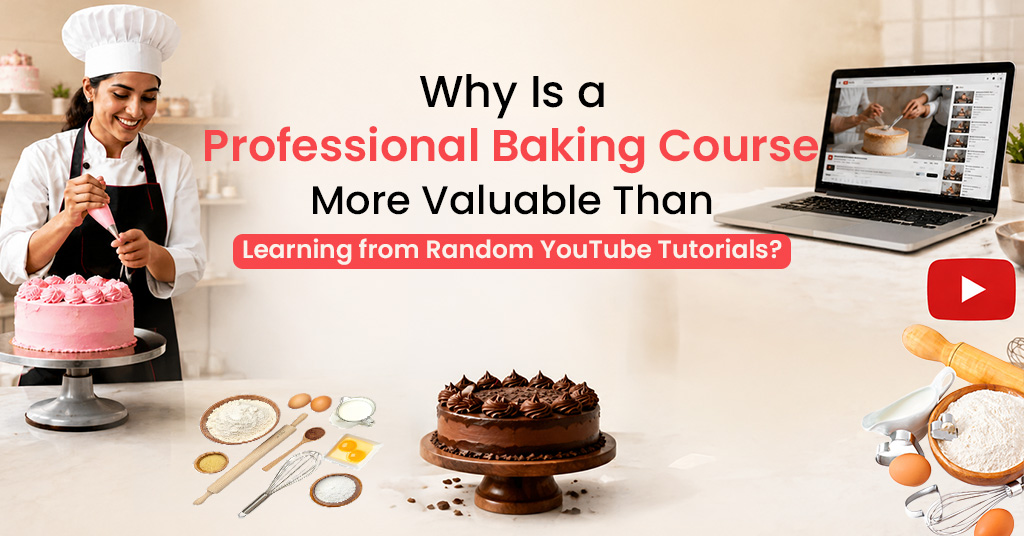

There is a moment most self-taught bakers know well. The video made it look easy. The steps seemed clear. But somewhere between the screen and the oven, something went quietly wrong and there was no one there to explain why.
That moment is more common than people admit. Every serious baking institute in Chennai understands it, because that is often exactly what brings a student through the door. This blog looks honestly at why a professional baking course holds more lasting value than an education built from scattered YouTube tutorials. Watching cannot replace doing under guidance. Structured learning builds differently than random content consumption. Mistakes caught early shape a baker’s technique in ways unguided repetition never will. Professional training covers what tutorials routinely leave out the science, the context, and the reasoning behind every method. Accountability in a real classroom creates momentum that solo watching rarely sustains. And certification from a recognised institution carries weight that no playlist can offer. The sections below take each point in turn.
Watching a Technique Is Not the Same as Learning It
This is the part that catches most self-taught bakers off guard.
A video can demonstrate folding, piping, or tempering chocolate with complete visual clarity. What it cannot do is feel the consistency of the batter in the viewer’s bowl, or notice that their folding motion is deflating the mixture rather than incorporating air. The screen shows the action. It cannot see what the viewer is doing in response.
Professional training puts a knowledgeable instructor in the same room. Errors that would otherwise compound silently over months get identified and corrected in real time. The baker does not just observe the right technique, they are guided toward it in their own hands, with their own ingredients, in the moment it matters.
That is where genuine skill begins to take shape.
Structured Learning Builds Competence That Random Content Cannot
YouTube is built for engagement, not education. The algorithm suggesting the next video has no interest in whether the viewer has mastered the previous one. A beginner might watch an advanced sugar work tutorial after a basic sponge video, with nothing connecting the two in any meaningful sequence.
Professional courses are designed with intention. Each session reinforces what came before. Foundational knowledge evolves into applied technique, which then builds steadily toward independence. A baker who learns this way does not simply accumulate recipes, they develop an understanding that transfers across situations, including ones no tutorial ever thought to cover.
Early Correction Shapes a Baker More Than Rewatching Ever Will
Most baking errors are invisible to the person making them. A slightly overworked dough. A fold with too much force. A timing habit that works most of the time but quietly fails under different conditions. These errors settle into routine without announcement, and rewatching a video will not surface them.
In a structured course, an instructor observes. They notice small things early, before those things become deeply embedded habits. One well-timed correction shapes technique far more effectively than hours of repeated independent practice. This is not a criticism of self-learning, it is an honest account of how skill develops differently under guidance.
Professional Training Covers What Most Tutorials Quietly Skip
The polished final result is what tutorials show best. What they rarely cover is everything surrounding it, how humidity affects dough behaviour, why certain ingredient ratios produce different crumb structures, how to troubleshoot when a recipe behaves unexpectedly, and what professional standards actually look like from the inside.
Professional courses teach the complete picture. The science sits alongside the technique. The reasoning behind each method is explained rather than assumed. A baker who understands why something works can adapt when conditions change. A baker who only knows the steps remains dependent on those steps going exactly as shown.
Accountability Creates the Momentum That Solo Learning Rarely Builds
Learning alone makes it easy to drift. To avoid the difficult sessions. To stay comfortable with what already feels manageable and never push past it.
A professional course introduces structure the learner is accountable to. A fixed schedule. An instructor who notices both effort and absence. Peers working through the same material at the same pace. This environment does not create pressure, it creates consistency. And consistency, far more than early enthusiasm, is what shapes a baker across time.
Certification Reflects a Standard That Travels Beyond the Kitchen
For anyone moving baking toward a business or professional role, recognised certification communicates something concrete. It shows the baker has been assessed against a defined standard, completed a structured curriculum and earned acknowledgement from an institution that stands behind its programmes. That is not something a saved playlist can provide.
Back to That Moment
The video looked easy. The steps seemed clear. And then something went wrong without explanation.
That moment does not mean the baker lacks ability. It means they were learning without the support real learning requires. The difference a structured course makes builds gradually across sessions, corrections, and growing confidence until the kitchen stops feeling uncertain and starts making sense. For bakers ready to make that shift, baking classes in Chennai Velachery at Zeroin Academy offer exactly this kind of progression practical, guided and built to stay with a baker long after the final session ends.
The gap between watching and truly knowing is real. Structured learning is how it closes.